conll-c, conllu-c and interoperability with UD
Let’s now look specifically at the cxn-machine-readable: and examples fields of the yaml file.
Although formal properties (i.e., morphosyntactic ones) are only part of the elements needed to represent a construction, the vast majority of the corpora at our disposal are based on such annotations.
This implies two things:
- we have a lot of tools that allow us to manipulate formal and structural properties annotated on resources
- if we hope to leverage the automatic population of ItCon in the future, we need to understand how to make the most of the annotation we already have available
In the case of ItCon, we chose the formalism offered by Universal Dependencies for a number of reasons:
- ‘light’ syntactic formalism
- cross-linguistic compatibility
- wide availability of tools
- interoperability with grew match
- accuracy of automatic annotation
We therefore developed two formats (CoNLL-C and CoNLL-Uc) to represent the constructicon
in a way that is interoperable with UD resources and at the same time model the development of the resource
independently and in a machine-readable way.
The CoNLL-U format
UD corpora are annotated in a tabular format.
A treebank consists of a sequence of sentences: example
Each sentence contains:
- lines relating to words, consisting of 10 tab-separated fields. Each field expresses an annotation or a property relating to the word
- comments and metadata (identified by
#)
Each sentence represents a tree:

The CoNLL-C format
In ItCon each construction is associated with a file in .conllc format.
CoNLL-C builds on the CoNLL-U guidelines and extends them to represent the constraints required by our representation. In this format, a construction is a set of directed, acyclic, labeled graphs, with constructional elements as nodes and relations as edges — formalized this way to maximize compatibility with UD notation, so that constructions can be (semi-)automatically matched against UD-parsed sentences. Constructions are represented at the sentence, phrase, and word level: morphological constructions are graphs too, just below the word boundary (see Morphology).
For clarity we call each element of a construction a “token,” but since constructions can be represented below the word level, a token doesn’t always correspond to a word.
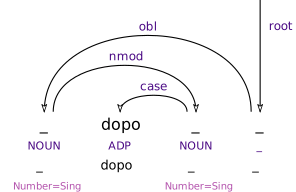
To start with, we can think of a construction as defined by a catena on a dependency tree, i.e., a set of nodes bound together by syntactic relations.



We want to represent our construction as an object of this kind:
General format rules
A .conllc file is plain UTF-8 text, containing (like CoNLL-U) token lines, construction-level
comment lines starting with #, and blank lines marking the end of a construction. A few
additional conventions apply to every field:
- fields must not be empty — an unconstrained field is written as
_, not left blank; - fields other than FORM and LEMMA must not contain spaces;
//marks a field as not applicable to that specific token (distinct from_, “no constraint”);- when more than one value can apply to a field (e.g. UPOS could be either
NOUNorVERB), the values are concatenated with a comma — see disjunction below.
The fields in CoNLL-C
The CoNLL-U base
As in CoNLL-U, in our format we also distinguish two types of lines:
- lines that represent minimal elements of the construction (typically, words), whose properties are expressed in tab-delimited fields
- lines introduced by
#, which represent properties of the construction as a whole.
Let’s focus on the element-lines and their fields. The previous construction, viewed in tabular format, looks like this:
| ID | FORM | LEMMA | UPOS | XPOS | FEATS | HEAD | DEPREL | DEPS | MISC |
|---|---|---|---|---|---|---|---|---|---|
| 1 | _ | _ | NOUN | S | Number=Sing | 4 | obl | _ | _ |
| 2 | dopo | dopo | ADP | E | _ | 3 | case | _ | _ |
| 3 | _ | _ | NOUN | S | Number=Sing | 1 | nmod | _ | _ |
| 4 | _ | _ | _ | V | _ | 0 | root | _ | _ |
In CoNLL-C we focus only on the internal elements of the construction, which will therefore have 3 elements (instead of 4). The basic idea is to use the fields to express the constraints that the construction must satisfy
- the ID field consists of letters rather than numbers. This is because in CoNLL-U numbers
also indicate that the elements must appear in that order and be adjacent. In our case, we want
the structure to allow not fixing the order or
inserting other material between one element and another of the construction. The ID field is the only
mandatory field in the format; for all the others it is possible to insert the value
_to indicate that no constraint is imposed on the field. In morphological constructions, sub-word elements get a compound ID: the letter of the word they belong to, plus a progressive number (A-1,A-2, …) — see Morphology. - the form field should be filled in when the form is fixed. For example, in the construction
above (N dopo N), dopo is a token fixed at the form level.
The form field can be expressed using a regular expression (by prefixing the string with
r). - the lemma field expresses constraints at the lemma level. For example, in the construction salta fuori che X, the first element (salta) can vary within the paradigm of the lemma saltare, which is the constraint we want to fix
- the upos field expresses constraints at the part-of-speech level and contains values from the Universal Dependencies inventory
- the feats field contains annotations on morphological features (e.g., constraints on gender, number, tense and mood of verbs…)
- the head field contains one of the identifiers in the ID field, or
0for the head of the construction - the deprel field contains values from the Universal Dependencies inventory,
and
rootfor the head of the construction
So far we have essentially expressed the same format as above, with minimal changes:
| ID | FORM | LEMMA | UPOS | FEATS | HEAD | DEPREL |
|---|---|---|---|---|---|---|
| A | _ | _ | NOUN | Number=Sing | 0 | root |
| B | dopo | dopo | ADP | _ | C | case |
| C | _ | _ | NOUN | Number=Sing | A | nmod |
For a deeper, field-by-field reference (LEMMA regex conventions, the full FEATS inventory,
DEPREL categories, metadata fields like function/horizontal_links/vertical_links), see
CoNLL-C field reference.
Further restrictions
Let’s now introduce additional constraints that take our format further away from CoNLL-U.
- A first difference concerns the possible presence of an external constraint on the dependency.
In our case, the construction N dopo N that we want to formalize appears as a modifier
in the wider context of the sentence. In fact, in the examples above, ora, giorno, and settore
are linked by the relation obl to another element of the sentence.
We can express this external constraint by specifying the relation root and indicating
root:obl in the
DEPRELfield of element A. -
As formalized so far, our construction expresses more patterns than we want. The construction N dopo N, in fact, requires the two Ns to be identical. We can express this constraint in the IDENTITY field, which has the following syntax:
field_name:ID.ID FORM LEMMA UPOS FEATS HEAD DEPREL IDENTITY A _ _ NOUN Number=Sing 0 root:obl FORM:C B dopo dopo ADP _ C case _ C _ _ NOUN Number=Sing A nmod FORM:A In the same way, agreement constraints can also be expressed (e.g. Subject and Verb must agree in number) — here by pointing at a specific key inside another element’s FEATS field,
FEATS.key:ID:ID FORM LEMMA UPOS FEATS HEAD DEPREL IDENTITY A _ _ NOUN _ 0 root:obl FEATS.Number:C B dopo dopo ADP _ C case _ C _ _ NOUN _ A nmod FEATS.Number:A -
In the case of the N dopo N construction, we need to consider other aspects (in this case, partially overlapping)

On the one hand, the construction requires the three elements to be all adjacent, with no material either between N and dopo, or between dopo and N. We can express this in the ADJACENCY field: if the adjacency field of element X contains the ID Y, it means that X must immediately precede Y in the sentence. Another aspect often related to the presence of other material is the possibility that the elements of the construction exhibit further modification.
ID FORM LEMMA UPOS FEATS HEAD DEPREL IDENTITY ADJACENCY A _ _ NOUN Number=Sing 0 root FORM:C _ B dopo dopo ADP _ C case _ A C _ _ NOUN Number=Sing A nmod FORM:A B In Grew, this is expressed as
A << B.Likewise, we can impose constraints on the kinds of other dependencies an element has. For example, in this case we want to filter cases like casa sua dopo casa mia that are not instances of the N dopo N we are looking for. This type of constraint should be reported in the EXCLUSION field, whose syntax is:
KEYWORD:FIELD=VALUE. Currently the only implemented keyword isCHILDREN, to indicate the types of relations we want to exclude. In our case, we want both nouns in the construction not to have, for example, adjectives modifying them: we can express this with the constraintCHILDREN:DEPREL=amod.ID FORM LEMMA UPOS FEATS HEAD DEPREL IDENTITY ADJACENCY EXCLUSION A _ _ NOUN Number=Sing 0 root FORM:C _ CHILDREN:DEPREL=amod B dopo dopo ADP _ C case _ A _ C _ _ NOUN Number=Sing A nmod FORM:A B CHILDREN:DEPREL=amod Note: some existing
.conllcfiles in the repository use the field nameWITHOUTinstead ofEXCLUSIONfor this column — the two names refer to the same field;EXCLUSIONis the current name taught here.
Semantic restrictions
Often important restrictions on the productivity of the construction come from the semantic field linked to a slot. Although UD does not provide for this type of annotation, in CoNLL-C two fields (SEM_FEATS and SEM_ROLES) are dedicated to specifying such restrictions.
-
For semantic features (SEM_FEATS), it is possible to specify the ontological class for nouns and verbs (
OntoClass), the Aktionsart for verbs (Aktionsart), and the class from dedicated ontologies for adjectives and adverbs (AdjClassandAdvClass). If, for example, we want to formalize a subconstruction of the previous construction, restricting productivity to time nouns (ora dopo ora, giorno dopo giorno, but excluding settore dopo settore), we can express it as followsID FORM LEMMA UPOS FEATS HEAD DEPREL IDENTITY ADJACENCY EXCLUSION SEM_FEATS A _ _ NOUN Number=Sing 0 root FORM:C _ CHILDREN:DEPREL=amod time B dopo dopo ADP _ C case _ A _ _ C _ _ NOUN Number=Sing A nmod FORM:A B CHILDREN:DEPREL=amod time For the full tagset (Wordnet-derived ontological classes, Aktionsart traits and classes), see Semantic features.
-
Similarly, we can annotate the semantic role realized by the elements of the construction, following the taxonomy provided by the Unified Verb Index. For the full role hierarchy and worked examples, see Semantic roles.
Notes on field syntax
If we think in terms of constraints, to best express the possible restrictions on slots, we need to introduce some operations on possible values:
-
disjunction: if we think of the construction che X!, we cannot express the part of speech to be assigned to X with a single label. We want to represent different constructions, which include both adjectives (Che bello!) and nouns (Che noia!). To express the disjunction between two values (“ADJ” or “NOUN”) we can generally use a comma.
ID FORM LEMMA UPOS FEATS HEAD DEPREL IDENTITY ADJACENCY EXCLUSION A che che DET _ B det _ _ _ B _ _ ADJ,NOUN _ 0 root _ _ _ Disjunction can occur:
- in the LEMMA field (e.g.,
che,qual) - in the UPOS field (e.g.,
NOUN,PROPN,PRON) - for each morphosyntactic feature (e.g.,
VerbForm=Fin,Part) - for the dependency relation except root (e.g.,
det,amod) - for semantic roles and semantic features
- in the LEMMA field (e.g.,
-
negation: similarly, we may want to restrict productivity by excluding a value rather than listing possible values (for example: the slot can be filled by any category except a proper noun). In this case we use the exclamation mark to indicate it (
!PROPN).Negation can occur:
- in the LEMMA field (e.g.,
!che) - in the UPOS field
- for each morphosyntactic feature (e.g.,
VerbForm=!Fin) - for the dependency relation except root (e.g.,
!det) - for semantic roles and semantic features
- in the LEMMA field (e.g.,
-
conjunction: in the case of features and filters we wish to apply (EXCLUSION), we may want to express more than one constraint. For example, a certain element must be a noun of feminine gender and singular number. In continuity with the CoNLL-U format, this is expressed by the pipe symbol (
|, for exampleGender=Fem|Number=Sing).